
Install the app
How to install the app on iOS

Follow along with the video below to see how to install our site as a web app on your home screen.

Note: This feature may not be available in some browsers.

Sticky Military and Veterans thread

U.S. Department of Defense Order - ARMY


TEAM

Four soldiers make up a team — a noncommissioned officer and three junior enlisted soldiers. Teams with special functions may also include officers or warrant officers. An infantry fire team might include two riflemen, one of whom is the team leader; a grenadier and an automatic rifleman, who is used when small reconnaissance or special missions are required. Teams can serve as a base-of-fire or as a maneuver element. 4 Soldiers

SQUAD
Two teams make up a squad, which has four to 10 soldiers. In an infantry squad, the teams divide duties: one serves as a base-of-fire element, while the other serves as the maneuver element. A staff sergeant is often in charge. Commanded by a Staff Sergeant of 10 Soldiers

PLATOON
A platoon consists of a few squads and up to a few dozen soldiers. They’re generally run by a lieutenant, often with a noncommissioned officer as second in command. An infantry platoon might include a weapons squad, which is divided into two M240 machine gun teams, and two close-combat missile teams armed with Javelin missiles. Commanded by a Lieutenant of 36 Soldiers

BATTALION

Battalions consist of four to six companies and can include up to about 1,000 soldiers. They can conduct independent operations of limited scope and duration and are usually commanded by a lieutenant colonel. There are combat arms battalions, as well as combat support and combat service support battalions. An armor or air cavalry unit of equivalent size is known as a squadron. Commanded by a Lieutenant Colonel of 1000 Soldiers

BRIGADE
A brigade consists of a few battalions and anywhere from 3,000 to 5,000 soldiers. A colonel is generally in command. For historical reasons, armor and Ranger units of brigade size are called regiments, and the equivalent Special Forces units are called groups. In 2016, the Army reorganized its brigades into brigade combat teams, which are autonomous modular brigades that most commonly include one combat arms brigade and its assigned support and fire units. Commanded by a Colonel of 5000 Soldiers

DIVISION

Usually commanded by a major general, divisions are made up of three or four brigades and include 10,000 to 15,000 soldiers. Current divisions include airborne, armored, infantry and mountain divisions. Each can conduct major tactical operations and sustained battlefield operations. They are numbered and assigned missions based on their structure. Commanded by a Major General of 15000 Soldiers

CORPS

A corps includes two to five divisions with anywhere between 20,000 and 45,000 soldiers. A lieutenant general is in command. The corps is the highest level of command that can provide operational direction for actual combat. Higher levels are concerned with administration rather than operations. The current active corps are I Corps at Fort Lewis, Washington; III Corps at Fort Hood, Texas; and XVIII Airborne Corps at Fort Bragg, North Carolina. Commanded by a Lieutenant General of 45000 Soldiers

FIELD-ARMY

A field army consists of two or more corps and is run by a general or lieutenant general. First Army serves as a mobilization, readiness and training command; Third Army, or U.S. Army Central, commands all Army forces for U.S. Central Command; Fifth Army, or U.S. Army North, commands all Army forces for U.S. Northern Command; Sixth Army, or U.S. Army South, commands all Army forces for U.S. Southern Command; Seventh Army, or U.S. Army Europe, commands all Army forces for U.S. European Command; Eighth Army commands all U.S. Army forces in South Korea; and Ninth Army, or U.S. Army Africa, commands all Army forces for U.S. Africa Command. Commanded by a 4 Star General of 90000 Soldiers

ARMY-GROUP

A group consists of four or five field armies and between 400,000 and 1 million soldiers. They’re commanded by a general and are considered self-sufficient for indefinite periods. They’re usually responsible for planning and directing campaigns in particular geographic areas. To differentiate them from field armies, groups are usually written with Arabic numerals (example - 12th Army Group) as opposed to having their number written out. Commanded by a 4 Star General of 400000 Soldiers

ARMY-REGION

These are only used in times of large-scale war, such as World War II. They usually consist of three or more field armies, with about 1 million to 3 million soldiers. They’re generally headed by a four- or five-star general. Commanded by a 5 Star General of 999999 + Soldiers


US ARMY SPC 5 whitefish Reporting
Viet-Nam Combat Veteran


Last edited:

2024 Veterans Day Free Meals and Restaurant Deals and Discounts

2024-veterans-day-restaurants-deals.jpg


Looking for Veterans Day restaurant military discounts for 2024? This list will be updated regularly as new discounts come in. All of the discounts have been confirmed, either through press release or direct communication with the company. Check out all the other discounts being offered this Veterans Day.

Veterans Day Free Meals

Code:
https://www.military.com/veterans-day/restaurants-veterans-day-military-discounts.html?ESRC=mr_241104.nl&utm_medium=email&utm_source=mr&utm_campaign=20241104#vetsdayrestaurantdiscounts


US ARMY SPC 5 whitefish Reporting
Viet-Nam Combat Veteran
 

History of Veterans Day

veterans-day-marines.webp


History of Veterans Day


World War I – known at the time as “The Great War” – officially ended when the Treaty of Versailles was signed on June 28, 1919, in the Palace of Versailles outside the town of Versailles, France. However, fighting ceased seven months earlier when an armistice, or temporary cessation of hostilities, between the Allied nations and Germany went into effect on the eleventh hour of the eleventh day of the eleventh month. For that reason, November 11, 1918, is generally regarded as the end of “the war to end all wars.”

Veterans Day continues to be observed on November 11, regardless of what day of the week on which it falls. The restoration of the observance of Veterans Day to November 11 not only preserves the historical significance of the date, but helps focus attention on the important purpose of Veterans Day: A celebration to honor America’s veterans for their patriotism, love of country, and willingness to serve and sacrifice for the common good.


Veterans Day Timeline

1919

In November 1919, President Wilson proclaimed November 11 as the first commemoration of Armistice Day with the following words: “To us in America, the reflections of Armistice Day will be filled with solemn pride in the heroism of those who died in the country’s service and with gratitude for the victory, both because of the thing from which it has freed us and because of the opportunity it has given America to show her sympathy with peace and justice in the councils of the nations…”

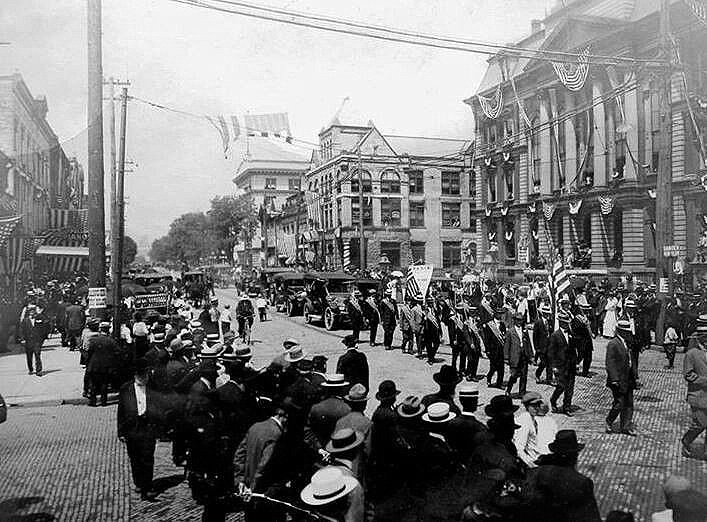
1920s veterans day parade

The original concept for the celebration was for a day observed with parades and public meetings and a brief suspension of business beginning at 11:00 a.m.

1926

The United States Congress officially recognized the end of World War I when it passed a concurrent resolution on June 4, 1926, with these words:
Whereas the 11th of November 1918, marked the cessation of the most destructive, sanguinary, and far reaching war in human annals and the resumption by the people of the United States of peaceful relations with other nations, which we hope may never again be severed, and

Whereas it is fitting that the recurring anniversary of this date should be commemorated with thanksgiving and prayer and exercises designed to perpetuate peace through good will and mutual understanding between nations; and

Whereas the legislatures of twenty-seven of our States have already declared November 11 to be a legal holiday: Therefore be it Resolved by the Senate (the House of Representatives concurring), that the President of the United States is requested to issue a proclamation calling upon the officials to display the flag of the United States on all Government buildings on November 11 and inviting the people of the United States to observe the day in schools and churches, or other suitable places, with appropriate ceremonies of friendly relations with all other peoples.

1938

An Act (52 Stat. 351; 5 U. S. Code, Sec. 87a) approved May 13, 1938, made the 11th of November in each year a legal holiday—a day to be dedicated to the cause of world peace and to be thereafter celebrated and known as “Armistice Day.” Armistice Day was primarily a day set aside to honor Veterans of World War I,

1954

In 1954, after World War II had required the greatest mobilization of soldiers, sailors, Marines and airmen in the Nation’s history; after American forces had fought aggression in Korea, the 83rd Congress, at the urging of the Veterans service organizations, amended the Act of 1938 by striking out the word “Armistice” and inserting in its place the word “Veterans.” With the approval of this legislation (Public Law 380) on June 1, 1954, November 11th became a day to honor American Veterans of all wars.

Later that same year, on October 8th, President Dwight D. Eisenhower issued the first “Veterans Day Proclamation” (PDF) which stated: “In order to insure proper and widespread observance of this anniversary, all Veterans, all Veterans’ organizations, and the entire citizenry will wish to join hands in the common purpose. Toward this end, I am designating the Administrator of Veterans’ Affairs as Chairman of a Veterans Day National Committee, which shall include such other persons as the Chairman may select, and which will coordinate at the national level necessary planning for the observance. I am also requesting the heads of all departments and agencies of the Executive branch of the Government to assist the National Committee in every way possible.”

1958

In 1958, the White House advised VA’s General Counsel that the 1954 designation of the VA Administrator as Chairman of the Veterans Day National Committee applied to all subsequent VA Administrators. Since March 1989 when VA was elevated to a cabinet level department, the Secretary of Veterans Affairs has served as the committee’s chairman.

1968

The Uniform Holiday Bill (Public Law 90-363 (82 Stat. 250)) was signed on June 28, 1968, and was intended to ensure three-day weekends for Federal employees by celebrating four national holidays on Mondays: Washington’s Birthday, Memorial Day, Veterans Day, and Columbus Day. It was thought that these extended weekends would encourage travel, recreational and cultural activities and stimulate greater industrial and commercial production. Many states did not agree with this decision and continued to celebrate the holidays on their original dates.

1971

The first Veterans Day under the new law was observed with much confusion on October 25, 1971. It was quite apparent that the commemoration of this day was a matter of historic and patriotic significance to a great number of our citizens, and so on September 20th, 1975, President Gerald R. Ford signed Public Law 94-97 (89 Stat. 479), which returned the annual observance of Veterans Day to its original date of November 11, beginning in 1978. This action supported the desires of the overwhelming majority of state legislatures, all major veterans service organizations and the American people.


US ARMY SPC 5 whitefish Reporting
Viet-Nam Combat Veteran
 
Wow, dead thread.
I was USAF 80 - 84. Anyone here that was AFRTS during that time? I was in Inçerlik, Turkey and Zarrogoza, Spain.
 
Back
Top