

E
Ernesto Van der Sar

The order followed a familiar pattern. It was requested by beIN Sports, which holds the exclusive French rights to most WTA tour matches. A day later, the broadcaster secured a similar order against Cloudflare.
In its initial request, beIN asked for penalties of €2,000 per day for each domain that two of the VPN providers failed to block. The court refused to grant that, however, as nothing showed that the providers intended not to comply. If problems arose, the parties could return to court. That's exactly what happened.
beIN Loses Penalty Request
As first reported by L'Informé, the broadcaster went back to the Paris court, complaining that VPN providers and Cloudflare had not fully blocked the sites. This time, it requested a daily penalty of €10,000 for every domain that remained accessible.
Cloudflare, Surfshark and NordVPN, all represented by the same lawyer, cited technical constraints and said they had done their best to comply. Proton was also targeted but did not show up at the hearing.
The blocking efforts were indeed not bulletproof. Cloudflare blocked three of the four sites, but only through its CDN. Surfshark and NordVPN blocked six of eleven, and only through the DNS service on their servers in France.
'Reasonable Effort'
For the court, those measures were enough. In two rulings issued on October 7, it concluded that the intermediaries must make a reasonable effort to block the sites, but they don't have to guarantee the outcome, in line with EU Court of Justice case law. The case files also showed that all companies had carried out the orders, at least in part.
"The requested penalty (…) therefore does not appear necessary or proportionate, given the need to strike a fair balance between the protection of the intellectual property rights of copyright and neighboring rights holders, and the freedom to conduct a business enjoyed by economic operators," the court wrote, as quoted by L'Informé (translated).
The original blocking orders themselves remain in effect until the end of the WTA season, which is currently set for November 14. Meanwhile, beIN can still appeal.
The outcome mirrors the Paris court's ruling in Canal+'s case against Cloudflare last month. There, Canal+ was refused daily penalties of €50,000 per site, as the court concluded that Cloudflare only had to take reasonable measures, which it did by blocking through its CDN.
DNS resolver Quad9 is next in line. According to the Swiss foundation, beIN wants €10,000 per domain, per day, which adds up to €580,000 a day. Quad9's position is different, however, as it isn't blocking any of the domains at all. A decision on that request is expected later this month.
Appeals Court Hits Pause
The penalty rulings are not the only setback for rightsholders. The VPN providers are also fighting the blocking orders directly, and that effort just got room to run.
Last year, NordVPN, Proton and CyberGhost appealed one of the first VPN blocking orders, which French football league LFP obtained in May 2025.
At the request of the VPN providers, the Paris Court of Appeal put that case on hold on September 30. Instead of ruling on the appeal, it will wait for France's Supreme Court, the Cour de cassation, to decide on appeals against seven earlier rulings.
These rulings, issued in March and May this year, upheld blocking orders that Canal+ obtained against DNS providers. In the March cases, Google, Cloudflare and Cisco lost their appeals. Several DNS providers then took the matter to the Supreme Court.
The appeals court acknowledged that these cases are not identical to the VPN dispute. However, it sees enough overlap to pause the case and wait for the Supreme Court outcome.
"Despite the differences, namely that the seven decisions under appeal concern DNS providers rather than VPNs, and that they were issued at the request of the Canal Plus companies rather than LFP and LFP1, the present case has many legal questions in common with the rulings under appeal before the [Supreme Court]," the court writes (translated).
From the freeze order
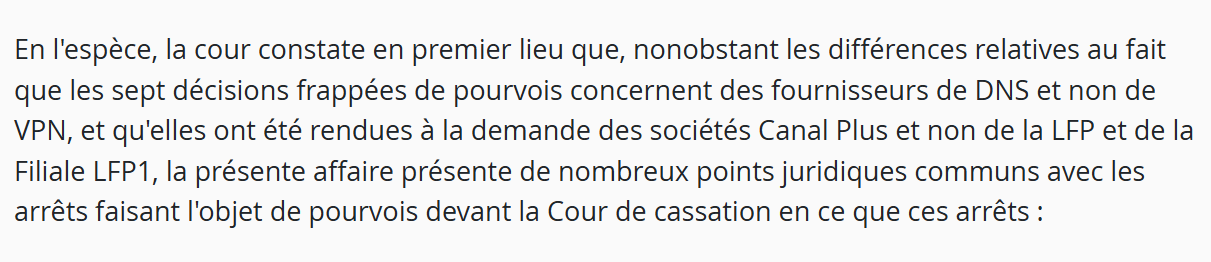
These overlapping questions include who can be ordered to help stop piracy, whether the French blocking law complies with EU law, how infringements must be proven, and when blocking measures are proportionate.
When the Supreme Court will rule on the matter is unknown, but the appeals court believes the outcome could affect the VPN case as well.
—
A copy of the Paris Court of Appeal's ruling (RG 25/09229) is available here (pdf).
From: TF, for the latest news on copyright battles, piracy and more.


