

E
Ernesto Van der Sar
Earlier this year, NVIDIA asked the California federal court to dismiss all BitTorrent allegations from the case.
The request didn't get very far. Judge Jon Tigar denied it, noting that the complaint mentioned BitTorrent only once, in a description of the pirate site Bibliotik, while describing the file-sharing protocol as "merely a tool, not a library or dataset."
That tool is now front and center in the case. Based on NVIDIA's own torrenting code, the authors allege that the company didn't disable uploading. In a second amended complaint, they now accuse NVIDIA of sharing pirated books with others.
Authors Amend Complaint
On Monday, Judge Tigar granted the authors permission to amend, based on documents NVIDIA produced between April and July.
A day later, the authors filed the new complaint. Unlike the proposed version they filed in July, it no longer redacts the names of the torrent tools and business partners, and it also shows several quotes from internal NVIDIA documents.
'Did Not Prevent Seeding'
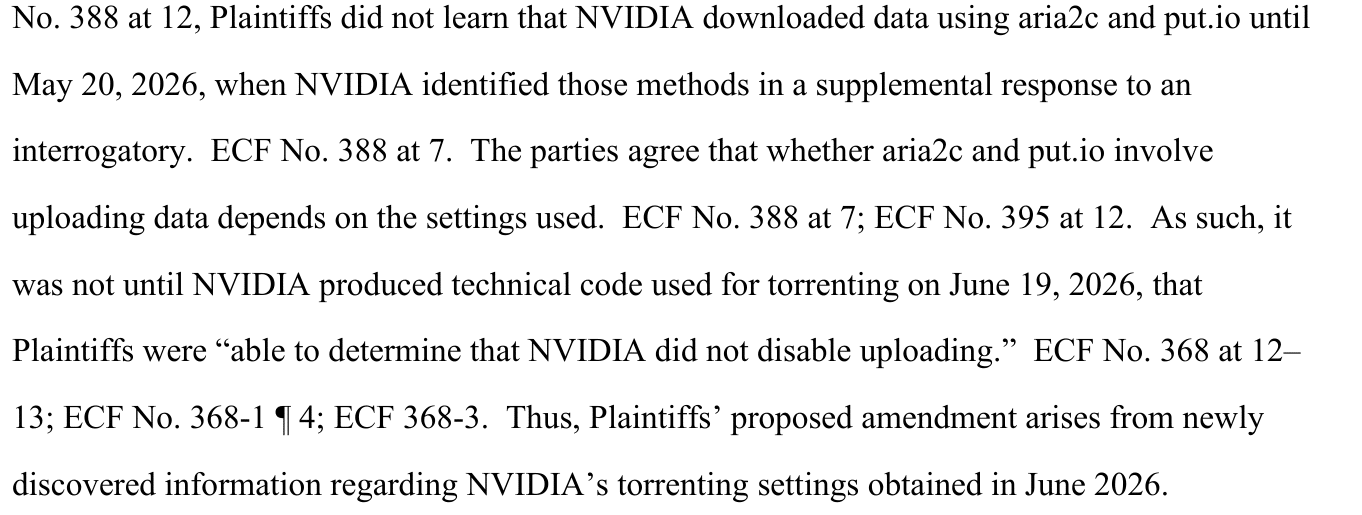
According to the amended complaint, NVIDIA downloaded pirated books from Anna's Archive, LibGen, and other shadow libraries using aria2c and put.io. The first is a command line download tool, the second is a long-running cloud service that downloads torrents for its users.
These tools can download files via BitTorrent, and the authors and NVIDIA both agree that whether they also upload data to others depends on the settings used. According to the authors, NVIDIA didn't prevent seeding altogether.
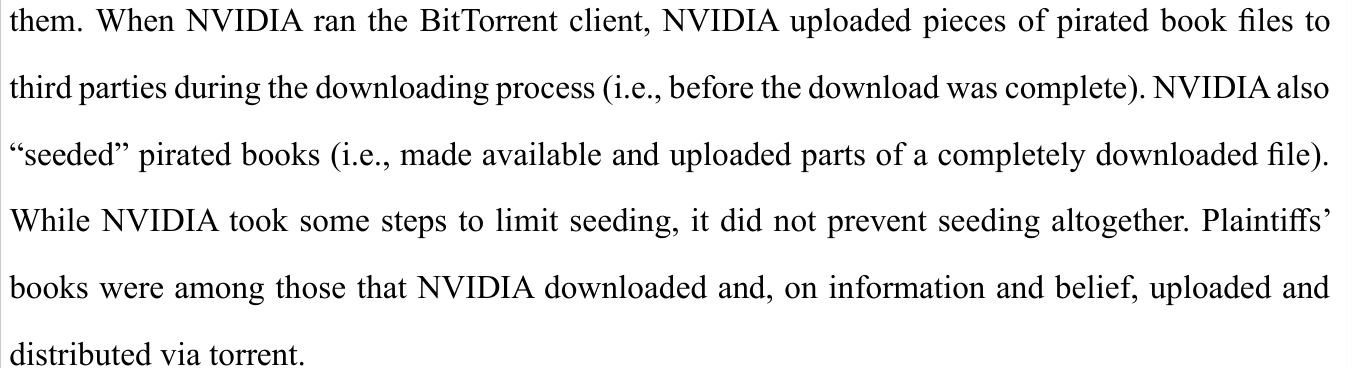
"When NVIDIA ran the BitTorrent client, NVIDIA uploaded pieces of pirated book files to third parties during the downloading process (i.e., before the download was complete). NVIDIA also 'seeded' pirated books (i.e., made available and uploaded parts of a completely downloaded file). While NVIDIA took some steps to limit seeding, it did not prevent seeding altogether," the complaint reads.
Seeding
The authors say they found out in June, when NVIDIA handed over the code it used for torrenting. Based on that code, they were "able to determine that NVIDIA did not disable uploading," the authors told the court.
Uploading
The complaint states that the authors' own books were among those NVIDIA downloaded. However, the claim that they were also uploaded to others is made "on information and belief," which essentially means the authors don't have direct knowledge of it.
Pirated Books for Adobe
In addition to the seeding claims, the authors also allege that NVIDIA shared the pirated books with business partners, including Adobe, through a "PDF Extraction Project" involving 250 million pages. These pages were acquired in part from shadow libraries such as Anna's Archive and LibGen.
According to the complaint, NVIDIA shared its pirated books with Adobe because it wanted to "get tokens out of PDFs to create differentiated models" and "include PDF extraction into our NeMo pipeline so that customers can leverage their PDF content".
The Adobe project
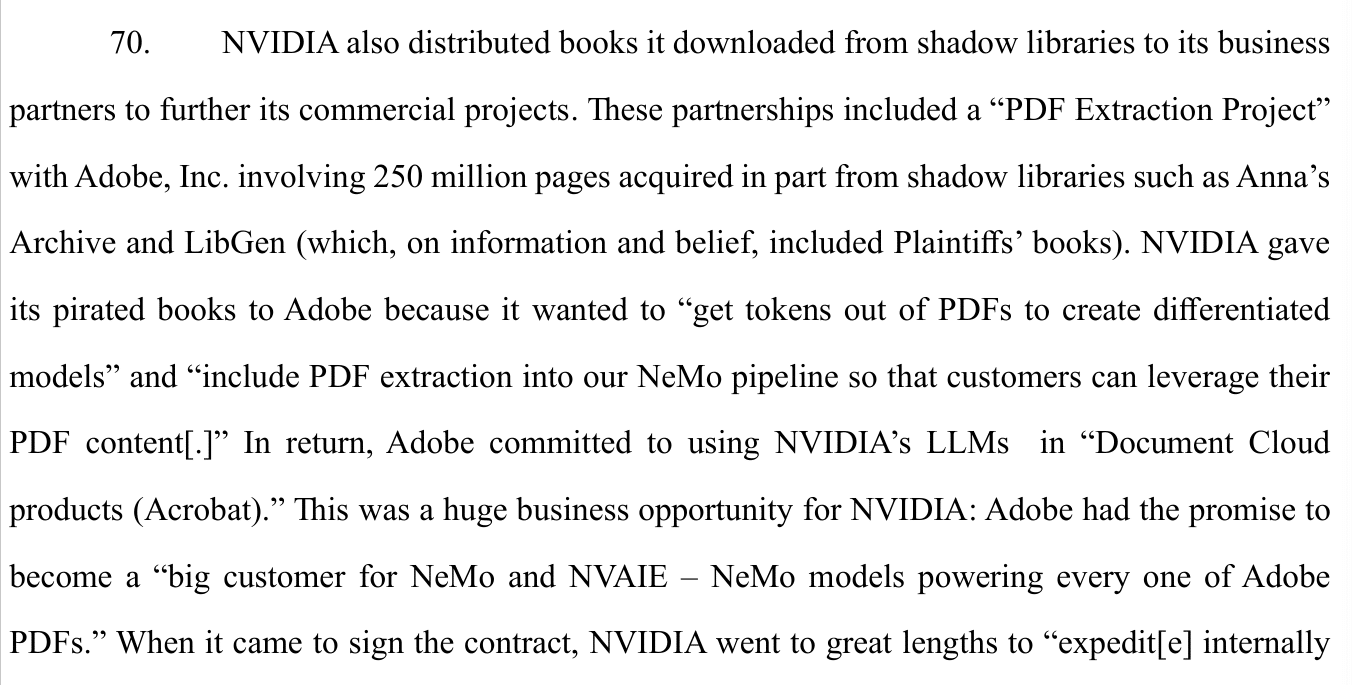
In return, the complaint says, Adobe committed to using NVIDIA's language models in some of its products. That made the deal a big opportunity for NVIDIA, with its NeMo AI models potentially "powering every one of Adobe PDFs," the authors write.
Adobe wasn't the only partner. The complaint also mentions partnerships with Cohere and Imbue that involved sharing NVIDIA's base training data and offering books acquired from shadow libraries. The authors believe their own books were shared with all three companies, but this is alleged on information and belief.
With these allegations, the amended complaint now accuses NVIDIA of distributing the books itself and of helping others to infringe, which falls under its existing direct and contributory infringement claims.
Meta's Seeding Fight
NVIDIA isn't the first AI company to face these seeding claims. In the authors' lawsuit against Meta, Judge Vince Chhabria previously ruled that Meta's AI training was fair use, but the BitTorrent claims outlived that ruling.
Evidence in that case also showed that a Meta engineer wrote a script to prevent seeding, but apparently not leeching, the downloading phase during which uploads also take place.
That could matter here too. Citing an earlier ruling, Judge Tigar noted that distributing the works for commercial purposes could affect NVIDIA's fair use defense.
Whether NVIDIA's seeding claims take the same path has yet to be seen, but its response to the amended complaint is already due in December.
—
A copy of the second amended complaint, filed at the U.S. District Court for the Northern District of California, is available here (pdf). Judge Tigar's order granting leave to amend can be found here (pdf).
From: TF, for the latest news on copyright battles, piracy and more.


