

E
Ernesto Van der Sar
Most of these cases allege that AI developers used copyrighted works to train LLMs without first obtaining authorization.
Meta is among a long list of companies now being sued for this allegedly-infringing activity, including a class action lawsuit filed by authors Richard Kadrey, Sarah Silverman, and Christopher Golden. This case has a clear piracy angle, as Meta used libraries of pirated books as training material.
Meta admitted the use of these unofficial sources to train its Llama model early on. At the same time, however, the company denied the copyright infringement allegations, noting that it would rely on a fair use defense, at least in part.
Motions for Summary Judgment
In March, both parties filed motions for partial summary judgment. Meta argued that its use of copyrighted material was 'fair'. It discussed the various fair use factors and stressed, among other things, that Meta's alleged infringements did not cause any market harm, nor can they be seen as competition for the original works.
Meanwhile, the authors argued that the downloading of millions of books cannot be classified as fair use, since the source of the books is clearly copyright-infringing. Therefore, they argued that Meta should be held liable for direct copyright infringement.
While the summary judgment motions are partial, as they don't cover the distribution claims (BitTorrent uploading), they are closely watched by other rightsholders and tech companies as potential sources of clarity on the fair use battle.
Meta Secures Fair Use Win
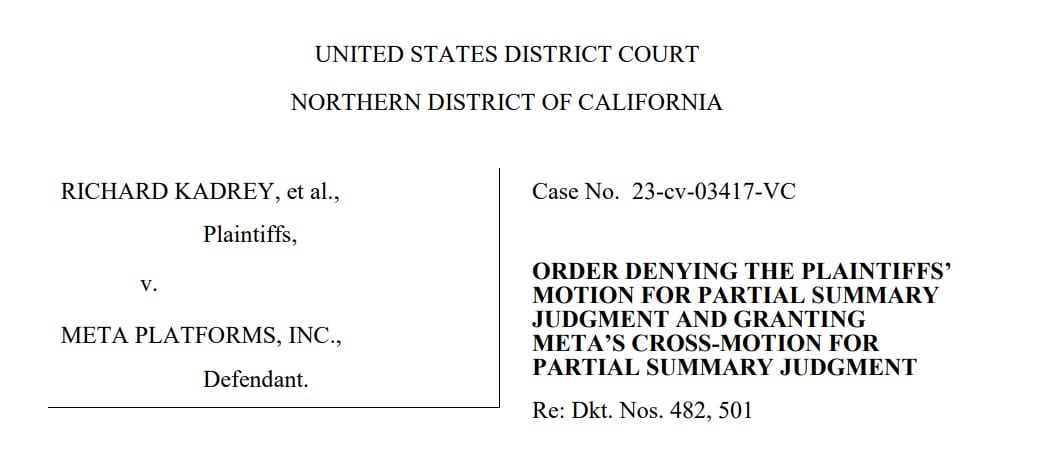
Yesterday, U.S. District Court Judge Vince Chhabria ruled on both motions, which at first sight offers a clear win for Meta. The court denied the authors' motion to hold Meta liable for direct copyright infringement after it obtaining pirated books from shadow libraries via BitTorrent.
Judge Chhabria also granted Meta's cross-motion for partial summary judgment, concluding that Meta's use of the copyrighted books for LLM training indeed qualifies as fair use based on the arguments presented.
The order
The ruling centers around an evaluation of the various fair use factors, with "market harm" explicitly identified as the most important element of fair use.
The court acknowledged the transformative nature of AI training, noting that Meta's use of the books had a "further purpose" and "different character" than the original works, as LLMs are "innovative tools that can be used to generate diverse text and perform a wide range of functions."
No Market Harm
The authors presented two main theories of market harm, both of which the court ultimately rejected as "clear losers".
First, the authors argued that Llama could recite significant portions of their books, thereby allowing users to access the works for free. The court found this theory unviable, citing expert testimony that Llama could not generate more than 50 words from any of the plaintiffs' books, even with "adversarial prompting".
Second, the plaintiffs argued that Meta's unauthorized copying harmed the relatively new market for AI training licensing. The court dismissed this too, ruling that the harm from the loss of licensing fees is not "cognizable".
The court also identified a third argument, which the authors didn't pursue in great detail; market dilution. Under this theory, AI models trained on copyrighted works can generate "countless works that compete with the originals, even if those works aren't themselves infringing," Judge Chhabria wrote.
This market dilution or indirect substitution argument could prove to be key in AI fair use cases, Judge Chhabria stressed.
"No other use—whether it's the creation of a single secondary work or the creation of other digital tools—has anything near the potential to flood the market with competing works the way that LLM training does," the Judge nnotes.
"If someone bought a romance novel written by an LLM instead of a romance novel written by a human author, the LLM-generated novel is substituting for the human-written one."
Dilution?
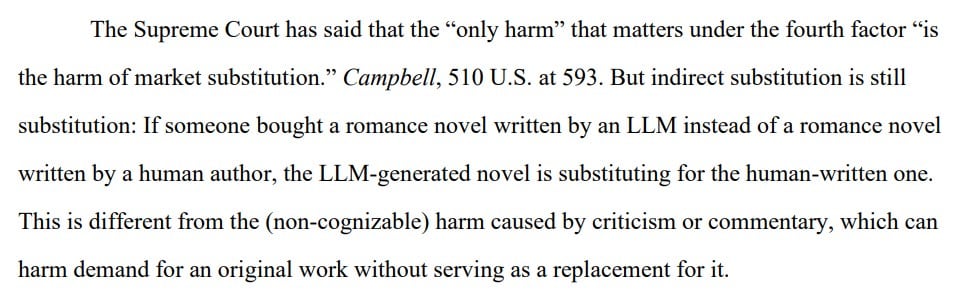
In this case, however, the authors provided no meaningful evidence on market dilution, relying on speculation rather than empirical data. Therefore, their motion was rejected, with the court granting Meta's fair use motion instead.
A Warning Shot for AI Developers
Despite the clear win, the court's ruling is a bittersweet victory for Meta. The motion only covers part of the copyright claim, as Meta's alleged distribution of pirated books was not part of it. In addition, the ruling only applies to the thirteen named authors included in this case.
The 'win' doesn't mean that the fair use defense will hold up in other AI-training copyright cases. In fact, the court hinted that Meta and others may have to get used to the idea of licensing content for this purpose.
Meta argued that a negative fair use ruling could stop AI technology in its tracks, as AI models need vast amounts of data to be trained on. However, the court dismissed this line of reasoning as ridiculous.
"The suggestion that adverse copyright rulings would stop this technology in its tracks is ridiculous," Judge Chhabria wrote.
"These products are expected to generate billions, even trillions, of dollars for the companies that are developing them. If using copyrighted works to train the models is as necessary as the companies say, they will figure out a way to compensate copyright holders for it."
The court ruling in favor of Meta is more the result of the authors' failure to adequately argue the market dilution argument, rather than a clear fair use win for AI training.
Judge Chhabria stated that, given the state of the record, the court has no choice but to grant summary judgment in favor of Meta. However, it certainly doesn't mean that similar arguments will hold up in other cases.
"As should now be clear, this ruling does not stand for the proposition that Meta's use of copyrighted materials to train its language models is lawful. It stands only for the proposition that these plaintiffs made the wrong arguments and failed to develop a record in support of the right one," the ruling reads.
—
A copy of the ruling, issued at the U.S. District Court for the Northern District of California, is available here (pdf). The court noted that Meta's motion for summary judgment on the DMCA claim will be granted in a separate order.
From: TF, for the latest news on copyright battles, piracy and more.


