

E
Ernesto Van der Sar

In its 2024 complaint, the pay-TV provider accused the company, also known as VSYS Host, of ignoring more than 500 takedown notices while pirate IPTV services streamed DISH's programming from its servers.
The defendants didn't appear or respond to the complaint before the judgment was entered. However, when DISH's lawyer asked them to confirm that they would comply with the permanent injunction, their Ukrainian attorney Taras Dementiev replied within a week.
Dementiev wrote that his clients were preparing to challenge the judgment, including with a motion for relief from judgment.
"We therefore cannot and will not confirm immediate compliance with a judgment whose validity is being formally and actively contested," he added.
Cox to the Rescue?
At the end of December, the owner of Virtual Systems filed an appeal at the Ninth Circuit. That effort was short-lived, as the appeals court dismissed it as untimely in January.
The defendants then hired Seattle law firm Williams Kastner and turned to the district court instead. In April, they filed a motion for relief from judgment, the only option left after a final judgment.
One of the key arguments in this motion was based on a fresh ruling. On March 25, the Supreme Court wiped out the $1 billion piracy judgment the major record labels had won against Internet provider Cox.
In that case, the Supreme Court narrowed contributory liability. A provider can be held liable if it induces infringement or offers a service that's tailored to infringement. The host argued that this undermined the court's earlier finding that it was liable.
DISH, meanwhile, kept monitoring. In an April letter to the defendants' new lawyer, it listed at least 176 instances in roughly three months where, it says, the host's servers were used to stream DISH programming in violation of the injunction. Many of these were the same pirate services that were named in the complaint, DISH added.
Seattle Servers
The host also argued that DISH misled the court about its Seattle servers, which it said were the only U.S. servers Virtual Systems ever used. According to an engineer who reviewed the routing data, none of the infringing material listed in the complaint was stored there.
DISH disagreed. A manager at NagraStar, which monitors piracy for DISH, declared that at least ten of the IP addresses listed in the complaint geolocated to the United States. After the lawsuit was filed, the same addresses started geolocating to Ukraine instead.
That change happened around the same time the Whois information for the IP range was last modified, on September 4, 2025. According to DISH, that was about a week after it asked the court for a default judgment.
The NagraStar manager added that at least one of the listed IP addresses was tied to the network number that the host's own engineer associated with its Seattle servers. DISH therefore argued that the defendants changed the information about the servers, including their location, after they were sued.
According to the host, it no longer has any servers in Seattle at all. In an April letter, its lawyer told DISH that the injunction resulted in it being booted from the Sabey data center.
"Your client's presentment of the order and injunction effected the eviction of our client Virtual Systems and terminated any contract to house servers at the data center," he wrote.
Interestingly, however, the VSYS homepage still lists Seattle as one of its data center locations at the time of writing.
Court Rejects Motion
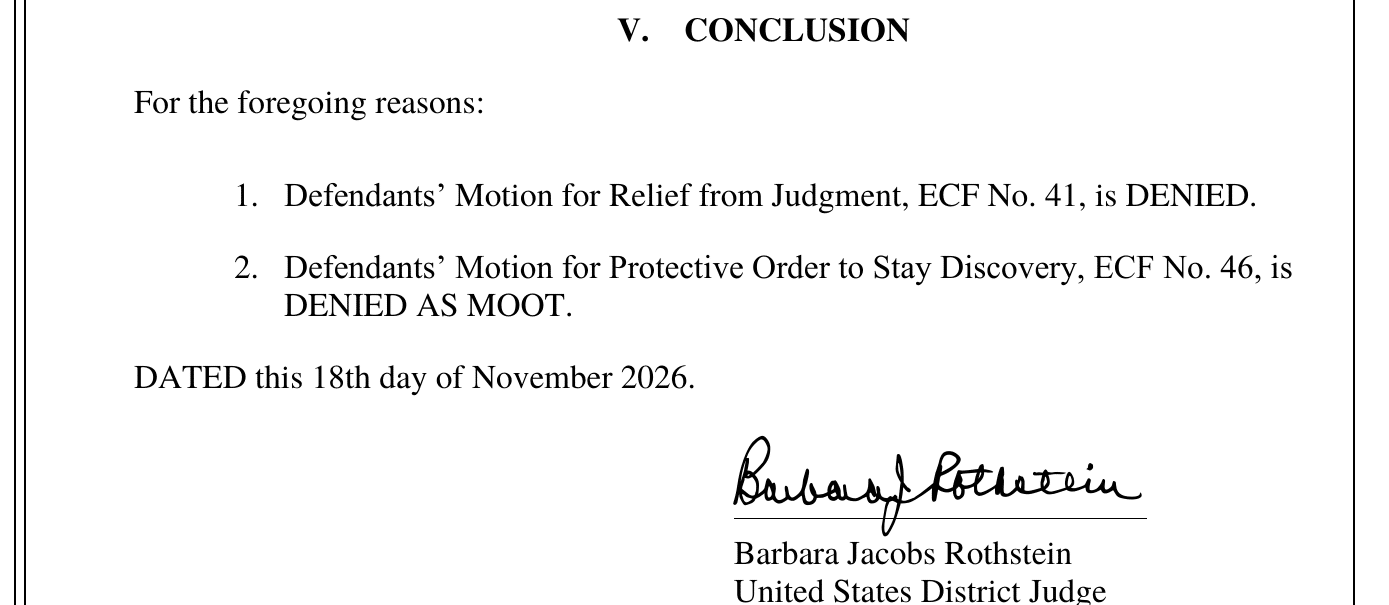
After taking in the arguments form both sides, Judge Barbara Jacobs Rothstein denied the motion for relief from judgment this week. The judge noted that the defendants had waited more than five months after the judgment, and offered "no explanation" for the delay.
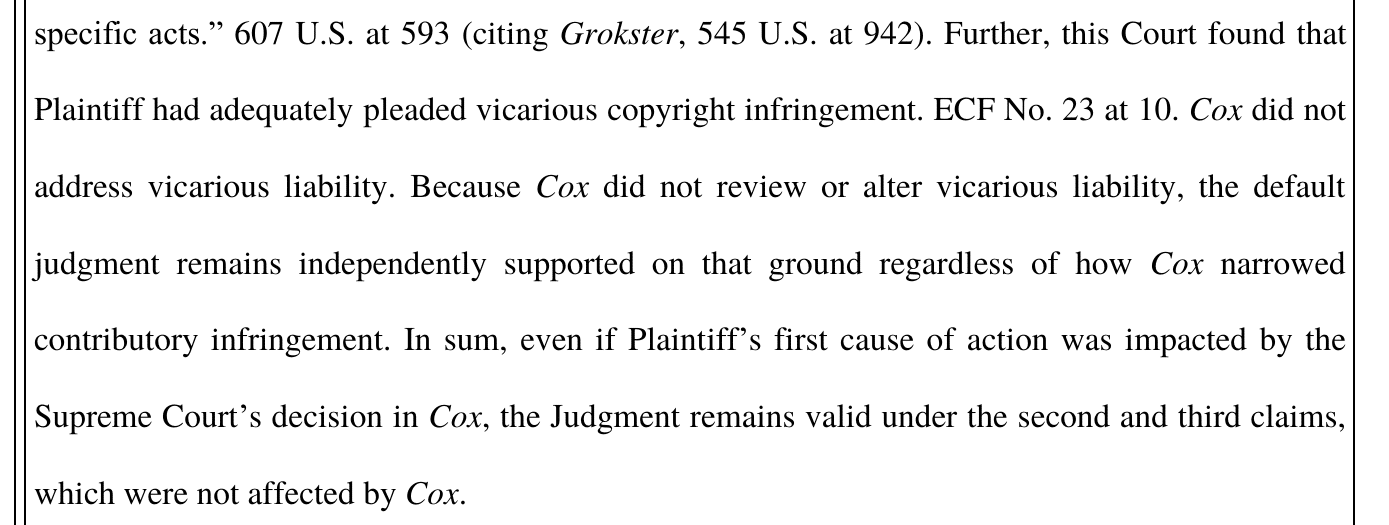
The Cox argument didn't help its case either. The court explained that a later change in the law doesn't normally reopen a final judgment. In this case, it doesn't change the outcome either way, as the Cox ruling didn't address vicarious liability at all.
"Because Cox did not review or alter vicarious liability, the default judgment remains independently supported on that ground regardless of how Cox narrowed contributory infringement," Judge Rothstein writes.
Cox doesn't change it
The Seattle argument failed as well. The court notes that the hosting company could have challenged DISH's allegations by appearing in time.
The court therefore denied the motion. The defendants' request to pause DISH's post-judgment discovery was denied as moot.
Denied
In its response, DISH noted that the host's motion painted Cox as an extreme case, pointing to an internal Cox email that read "F the DMCA!!!" and the fact that Cox only terminated 32 subscribers. The pay-TV provider wasn't impressed.
"Defendants' conduct is worse: Defendants publicly advertised their 'DMCA Ignored' policy to attract pirate streaming services and did not take action on a single DMCA infringement notice," DISH wrote.
The host does admit to some of the marketing. "Defendants admit that certain marketing materials historically used the phrase 'DMCA-Ignored' in connection with servers physically located in Ukraine," its answer to the complaint reads. At the same time, it denies having a 'DMCA-Ignored' policy, and argues that U.S. takedown procedures don't automatically apply to servers abroad.
Virtual Systems also has other problems. According to the company, both of its Kyiv data centers were hit by Russian missile strikes on September 23, taking them out of operation. Most virtual servers were running again from a new facility in Ukraine within days, and earlier this month it opened a new location in Warsaw, Poland.
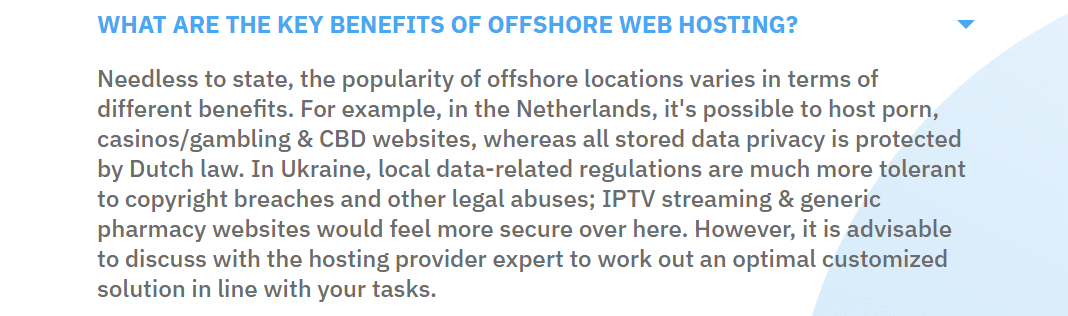
When we checked this week, its offshore hosting page still pitched Ukraine to IPTV services.
"In Ukraine, local data-related regulations are much more tolerant to copyright breaches and other legal abuses; IPTV streaming & generic pharmacy websites would feel more secure over here," it reads.
More tolerant to copyright breaches
—
A copy of Judge Rothstein's order denying the motion for relief from judgment is available here (pdf). DISH's response to the motion, with the supporting declarations, can be found here (pdf), and the defendants' answer and counterclaims here (pdf).
From: TF, for the latest news on copyright battles, piracy and more.


