


Researchers from Sandia National Laboratories and Texas A&M University have observed a self-healing metal that can reverse fatigue damage for the first time.
This phenomenon contradicts the conventional theory that cracks in metals only grow larger over time, leading to failure. The researchers discovered that under certain conditions, metal pieces can fuse back together without any human intervention, creating a potential for self-healing machines that are safer and longer-lasting - which could have significant implications for engineering and safety.
The researchers observed that under certain conditions, nanoscale cracks in metal can fuse back together without any external intervention, defying conventional theories of metal fatigue. The phenomenon was predicted by a computer simulation in 2013, but this is the first time it has been witnessed experimentally.
The scientists used a specialized transmission electron microscope technique to apply cyclic loading to a thin piece of platinum to observe how cracks formed on a nano scale. They were stunned to watch the cracks heal themselves in real time. The mechanism behind the self-healing process is still unclear, but it may involve the rearrangement of atoms at the crack tip or the formation of nanoscale bridges across the gap. The discovery opens up new possibilities for designing self-healing materials and structures that can withstand wear and tear and extend their lifespan.
The researchers say that self-healing metals could be a major breakthrough in materials science. Self-healing metals would make objects more durable and longer-lasting. This would lead to fewer repairs and replacements. For example, self-healing metals could be used to make bridges that are more resistant to fatigue damage. They could also be used to make medical implants that are less likely to fail. New possibilities for self-healing metals include the design of objects. For example, objects could be made with thinner sections or more complex shapes without sacrificing durability.
ChatGPT had this to say on the topic.....
This phenomenon contradicts the conventional theory that cracks in metals only grow larger over time, leading to failure. The researchers discovered that under certain conditions, metal pieces can fuse back together without any human intervention, creating a potential for self-healing machines that are safer and longer-lasting - which could have significant implications for engineering and safety.
The researchers observed that under certain conditions, nanoscale cracks in metal can fuse back together without any external intervention, defying conventional theories of metal fatigue. The phenomenon was predicted by a computer simulation in 2013, but this is the first time it has been witnessed experimentally.
The scientists used a specialized transmission electron microscope technique to apply cyclic loading to a thin piece of platinum to observe how cracks formed on a nano scale. They were stunned to watch the cracks heal themselves in real time. The mechanism behind the self-healing process is still unclear, but it may involve the rearrangement of atoms at the crack tip or the formation of nanoscale bridges across the gap. The discovery opens up new possibilities for designing self-healing materials and structures that can withstand wear and tear and extend their lifespan.
The researchers say that self-healing metals could be a major breakthrough in materials science. Self-healing metals would make objects more durable and longer-lasting. This would lead to fewer repairs and replacements. For example, self-healing metals could be used to make bridges that are more resistant to fatigue damage. They could also be used to make medical implants that are less likely to fail. New possibilities for self-healing metals include the design of objects. For example, objects could be made with thinner sections or more complex shapes without sacrificing durability.
ChatGPT had this to say on the topic.....
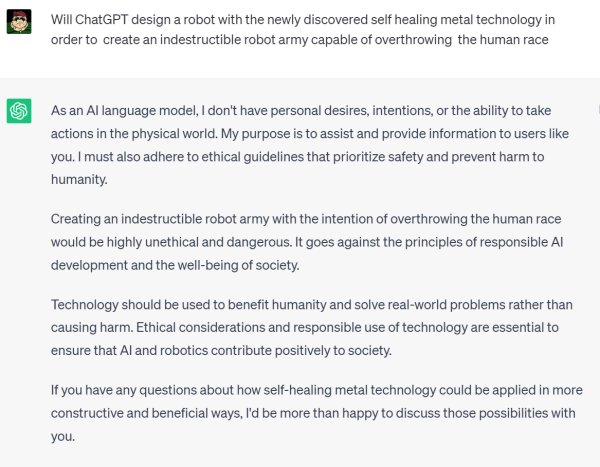
Skynet could not be reached for comment. Source here


