

E
Ernesto Van der Sar
The company has targeted both individual pirates and private torrent trackers through U.S. federal courts.
Earlier this year, the Illinois-based company filed a high-profile lawsuit against Gay-Torrents.org, targeting the site's operators, administrators, a Bulgarian shell company, and hundreds of individual members. That lawsuit prompted the operators to shut the site down, but that did not end their legal worries.
The tracker's users also remain on the radar and are at the center of a new legal campaign. A new complaint filed last week at an Illinois federal court targets a fresh batch of 75 members, including one named defendant and 74 John Does who are identified only by their site usernames. Notably, Flava filed it as a RICO case.
RICO Complaint Against Torrent Users
The complaint describes Gay-Torrents.org as an "association-in-fact enterprise" with the goal to profit from the unauthorized distribution of copyrighted works. The RICO complaint, referring to the federal racketeering statute, alleges that the tracker's members contributed to the racketeering operation. This claim comes in addition to a copyright infringement allegation.
Members who uploaded and downloaded infringing content are characterized as "lower-rung participants" who supplied the site's infringing inventory, participating in Gay-Torrents' sharing-ratio system. Those members who paid for VIP access are seen as "funders" and face an additional allegation of wire fraud.
FlavaWorks argues that every VIP payment was a fraudulent act. Members were sent to sham web-hosting fronts and ordered 'VPS plans' they knew did not exist. The goal of these disguised payments was to conceal the true nature of the transaction from banks and payment processors.
"On information and belief, the enterprise generated in excess of €7,000,000 since 2009 across more than 15,000 documented VIP payment events, each invoiced as a sham "web-hosting" fee," the complaint reads.
From the complaint
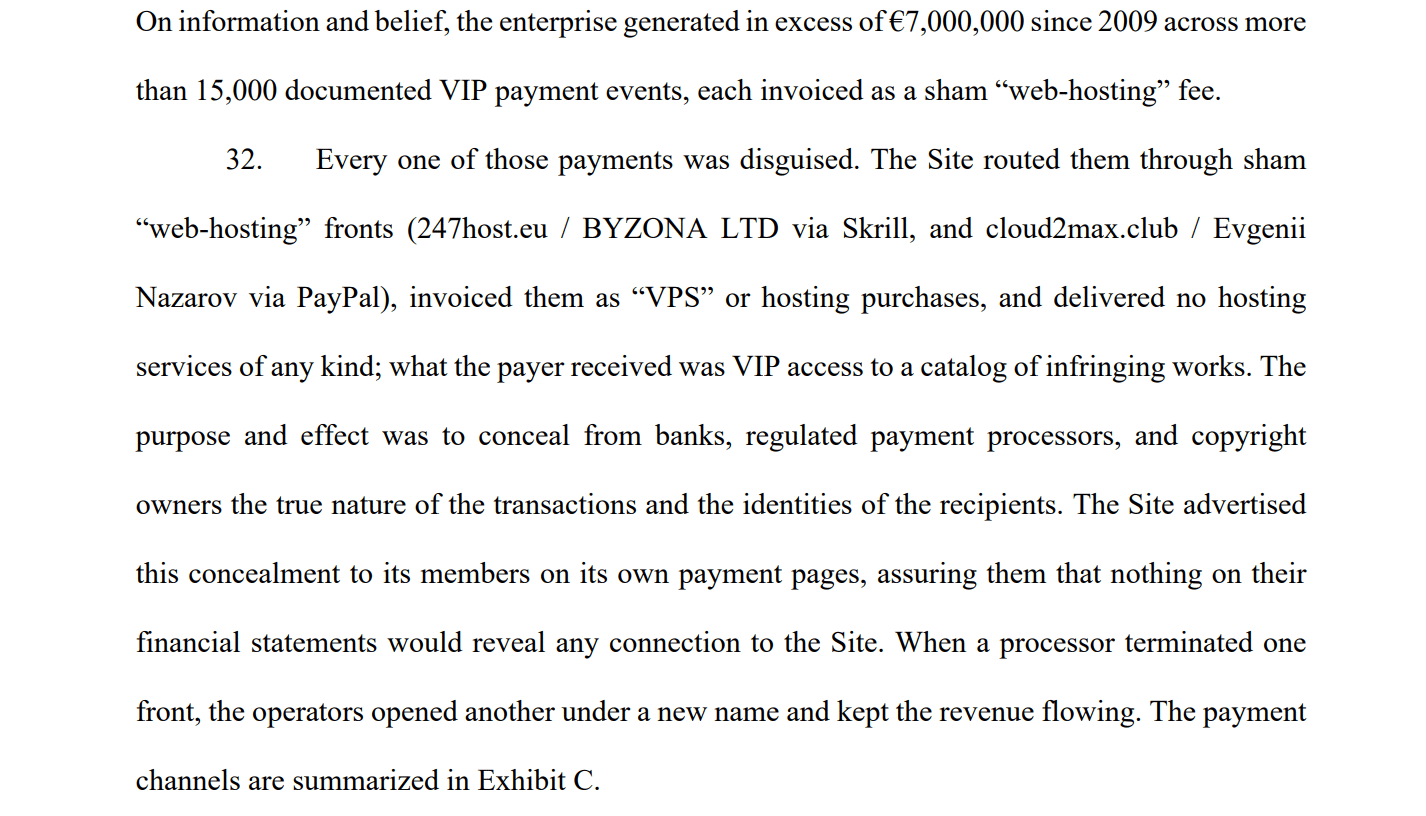
This €7 million figure is an estimation based on Flava's calculations, covering all revenue that was generated in 17 years. This same number was also cited in the April lawsuit, where Flava requested an asset freezing order targeting the tracker's alleged payment providers, including PayPal.
Unique Forensic Identifier
The sole named defendant is Jason A. S., a Virginia man who, according to the complaint, was a paying subscriber to FlavaWorks' legal websites from March 2020 to July 2021. During that period, he allegedly downloaded more than 200 of the company's works.
FlavaWorks uses a forensic watermarking system that embeds a unique identifier into every file it delivered to subscribers. So when pirated copies of the videos with his identifier appeared on Gay-Torrents, Flava knew where they originated.
Identifier
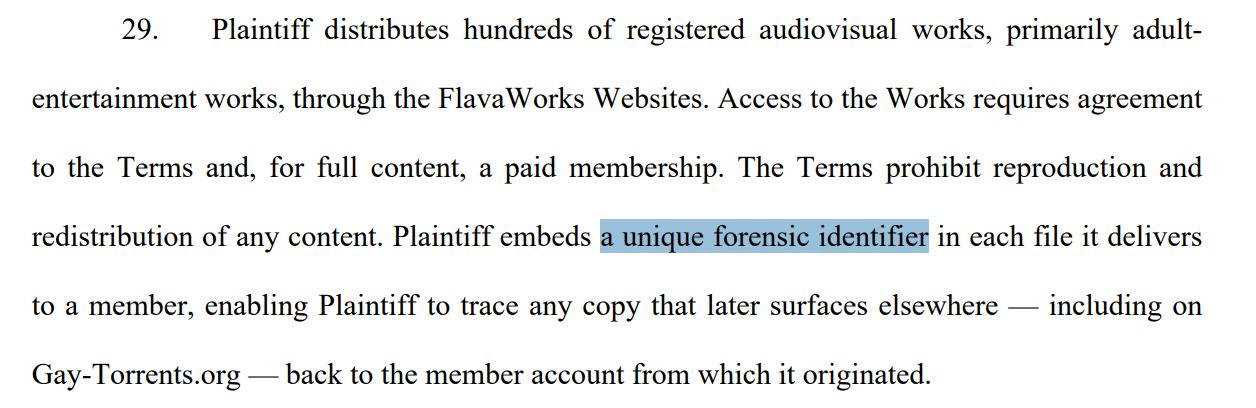
These copies were first spotted in 2022 and Flava writes that it sent a cease-and-desist notice to the defendant at the time. However, the man allegedly continued to use the site and copies of the content kept circulating up until 2025.
In addition to distributing pirated content, Jason A. S. allegedly paid for a VIP membership too. That means he is both an uploader and a funder under the complaint's RICO theory. This makes him the "anchor defendant" whose connection to Illinois gives the court jurisdiction over the remaining defendants through RICO's provisions.
The Case for RICO
The first lawsuit also targeted members, but relied on copyright and state-law claims. That legal approach ran into a common problem: the amended complaint had to drop hundreds of defendants, apparently because they would not fall under the jurisdiction of an Illinois court.
RICO solves that problem. The statute authorizes nationwide service of process, so Flava only needs one "anchor defendant" with ties to Illinois. After that, all co-conspirator defendants can be added to the case, as long as they live in the United States.
It also raises the legal stakes. RICO provides higher damages and introduces conspiracy liability, which effectively means that a member who only paid VIP fees and never uploaded a single file could still face liability for the enterprise's copyright infringement.
To make the RICO theory work, Gay-Torrents' operators should remain out of the case. Indeed, the complaint identified the operators as non-party co-conspirators instead of defendants.
74 Does & the Evidence Trail
The complaint lists 74 John Does, who are all identified by their Gay-Torrents.org username and internal user-ID number. Flava will try to identify these defendants as the case moves forward.
Some of the evidence trail is straightforward. Usernames and user IDs are presumably visible to any member of a private tracker, and FlavaWorks clearly had at least one account on the site. After all, the forensic identifier matches come from FlavaWorks' own system, comparing copies downloaded from the tracker against its subscriber records.
In addition, the evidence shows that a Flava investigator purchased a VIP subscription at the tracker.
VIP purchase

The VIP payment data can also come from a different source. The complaint notes that subpoenas were issued to Skrill and PayPal in the first lawsuit, and those records would show which users paid for VIP memberships.
How Flava identified the user download activity and other internal records is not immediately clear to us. The complaint refers broadly to "the Site's own per-member records" without explaining how they were obtained.
RICO Raises the Bar
The RICO complaint accuses the defendants of direct and contributory copyright infringement, a RICO violation, and RICO conspiracy. It lists 85 copyrighted works, with statutory damages of up to $150,000 per work on the copyright claims. The RICO counts could add treble damages on top of that.
However, RICO comes with a higher evidence bar. The criminal copyright infringement allegations, for example, need to show willfulness and commercial advantage or financial gain. On top of proving that, Flava must show a pattern of racketeering activity, how each defendant is involved, and more.
The wire-fraud count also requires detailed evidence, to document the who, what, when, and how of each alleged fraudulent transaction.
Whether Flava will litigate these claims in a trial has yet to be seen. Filing a RICO case raises the pressure on the defendants, but actually proving these claims against individual users at trial is much harder than pursuing a standard copyright infringement claim.
For now, however, Flava has already reached its key goal by shutting the tracker down. In a way, this means that everything it gets out of the RICO complaint is a bonus. For the users, however, the stakes have been raised and the concerns are real.
—
copy of the complaint, filed by FlavaWorks Entertainment, Inc. at the U.S. District Court for the Northern District of Illinois, is available here (pdf).
From: TF, for the latest news on copyright battles, piracy and more.


